


MicronJet™ is an innovative intradermal delivery device developed by NanoPass Technologies, a globally recognized company specializing in the development of virtually pain-free intradermal injection technologies for pharmaceutical and aesthetic applications.
With a size of less than 1 mm, the MicronJet™ 600 and MicronJet™ 800 devices provide an easy-to-use, reliable and efficient solution for precise intradermal delivery of substances, with minimal discomfort for the patient.
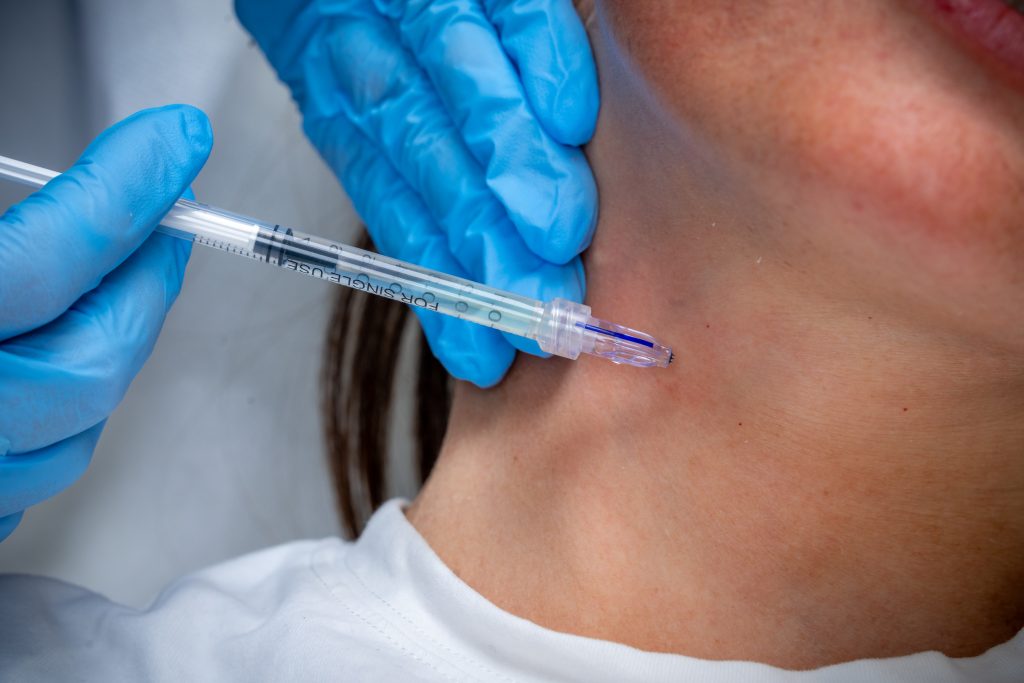
The technology allows the device to be used with any standard Luer-lock syringe (<3 ml) to inject products directly into the dermis, including polynucleotides, dermal fillers, botulinum toxin, mesotherapy solutions, PRP / IPRF, corticosteroids and lidocaine.
The MicronJet™ device carries CE Mark and FDA clearance as an intradermal delivery device for substances or pharmaceutical products approved for administration through this delivery route.
MEMS Technology
The MicronJet™ device is based on MEMS (Micro-Electro-Mechanical Systems) technology and features three microscopic hollow silicon-crystal pyramids that enable precise intradermal delivery of bioactive substances into the dermis.
This unique architecture ensures:
- consistent delivery depth
- precise intradermal injection
- reduced tissue trauma
- minimal patient discomfort
MicronJet™ 800 and MicronJet™ 600
The MicronJet™ range includes two versions designed for different treatment needs.
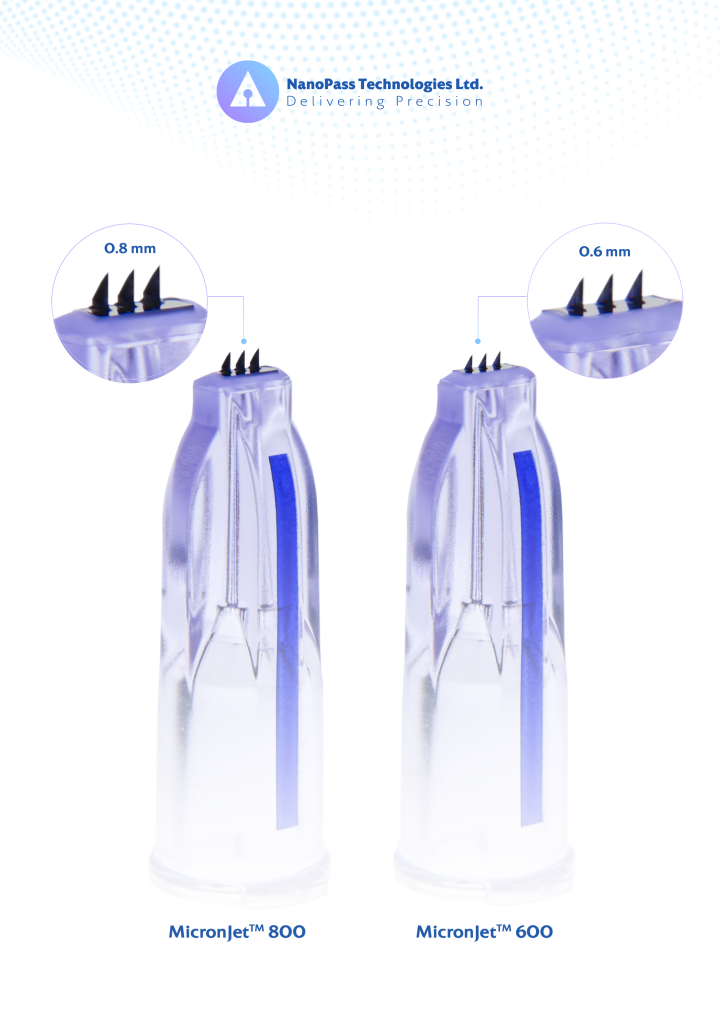
MicronJet™ 800
- penetration depth 0.8 mm
- suitable for medium- to high-viscosity substances
- flow equivalent to a 27G needle
MicronJet™ 600
- penetration depth 0.6 mm
- suitable for low- to medium-viscosity substances
- flow equivalent to a 30G needle
Both devices connect to any standard Luer-lock syringe (<3 ml).
Clinical Applications
The MicronJet™ device can be used across a wide range of aesthetic and dermatological treatments, including:
- Skin rejuvenation
- Polynucleotide treatments
- PRP therapies
- Mesotherapy
- Microtoxin techniques
- Hair restoration
- Hyperhidrosis treatments
- Scar improvement treatments
References
1.Chopra K, et al. A comprehensive examination of topographic thi ckness of skin in the human face. Aesthetic Surgery Journal. 2015;35(8):1007–1013.
2.Boca A, Fanian F, Smit R, Redaelli A, Goorochurn R, Issa H, Suk manskaya N, Philippon V, Dell’Avanzato RJ. Evaluation of the pe rformance and safety of a
new micro-needle technology in comparison with the classic need le on the antiaging effects of a biorevitalizing solution: a ra ndomized split-face/neck
study. Journal of Cosmetic Dermatology. 2024;23:3974–3985.
3.Diaspro A, Silenzi S. Microneedle for botulinum toxin: a random ized, case-control, single-blind study to assess clinical effica cy and patient
satisfaction. Plastic and Reconstructive Surgery Global Open. 2025;13:e6610.
4.Dell’Avanzato R, Gualdi A, Vescovi E, Basso M, Marchetti F, Lan franchi L, Redaelli A, Vitale MJ. Facial rejuvenation using a m icroneedle-based device with a
revitalizing solution and free hyaluronic acid. Journal of Cosmetic Dermatology. 2021;20:3701–3703.
5.Martin C, Leroux J-M, Molinari P, Diaspro A, Ballarini S. Feasi bility assessment on the usability, performance and safety of a non-crosslinked HA-based
injectable used with a microneedle device for skin-quality trea tments of delicate facial and neck areas. Poster presented at t he Aesthetic & Anti-Aging
Medicine World Congress (AMWC); Monaco, 2025.
6.Rzhevskiy A, Popov A, Pavlov C, Anissimov Y, Zvyagin A, Levin Y , Kochba E. Intradermal injection of lidocaine with a microneed le device to provide rapid
local anesthesia for peripheral intravenous cannulation: a rand omized open-label placebo-controlled clinical trial. PLoS ONE. 2022;17(1):e0261641.